
The Unified ‘Chain of Survival’: AHA Simplifies CPR Response Across Ages & Settings
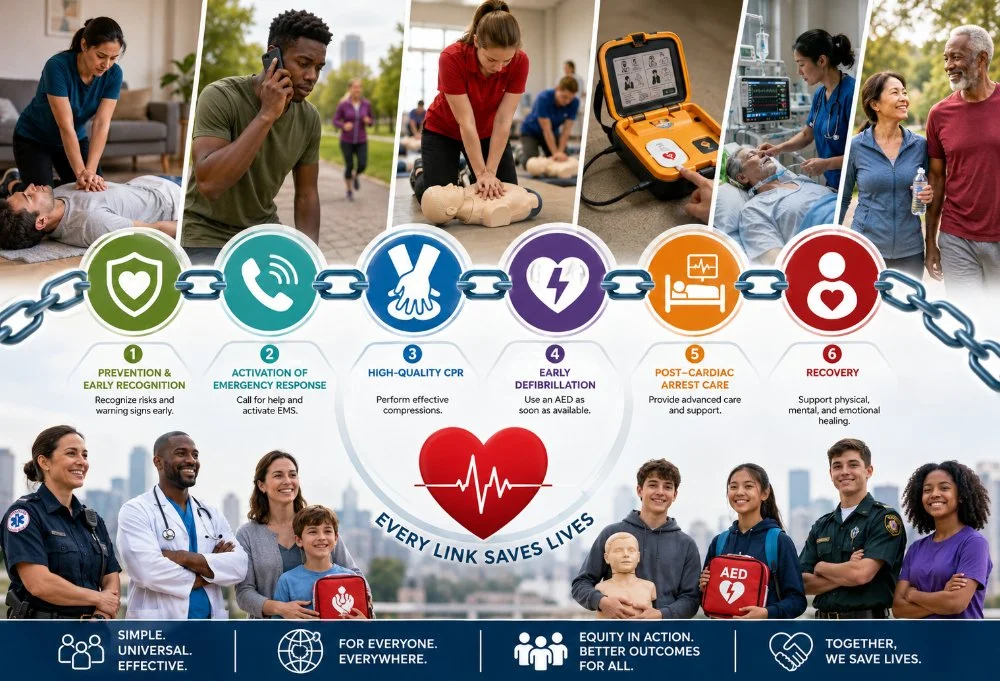
Every second matters when a heart stops beating. For decades, the American Heart Association (AHA) has guided the way emergency responders, healthcare workers, and everyday bystanders approach cardiac arrest. But the complexity of maintaining separate protocols for different ages and settings created a real barrier to learning, retention, and action. With the release of the 2025 CPR and Emergency Cardiovascular Care (ECC) guidelines, the AHA made a sweeping change that reshaped how the world understands lifesaving response.
At the center of that change is the unified chain of survival CPR framework, a single, streamlined model designed to work for everyone, everywhere.
Why the Old System Needed an Overhaul
Before October 2025, the AHA maintained four distinct Chains of Survival. Previously, the AHA maintained different chains for adult in-hospital, adult out-of-hospital, pediatric in-hospital, and pediatric out-of-hospital cardiac arrest. While each version was grounded in solid science, the layered structure created practical problems for instructors, students, and first responders who had to remember which chain applied to which situation. In high-stress emergencies, that kind of cognitive burden can cost precious time.
The CPR emergency response systems in use prior to 2025 also struggled to account for how modern communities actually experience cardiac arrest. Inequities in survival outcomes persist, and the unequal provision of CPR and use of an AED by lay rescuers contribute to worse outcomes, largely as a result of unequal access to lay rescuer CPR and AED training opportunities. Simplifying the framework was not just about convenience. It was about building a system that more people could learn, remember, and act on regardless of their background or training level.
The Six-Link Unified Chain Explained
The cornerstone of the AHA chain of survival simplification is the replacement of four separate chains with one universal model. The AHA has consolidated the previously separate Chains of Survival for adults, children, in-hospital, and out-of-hospital into a single, unified 6-link Chain of Survival. This simplification ensures that the core sequence of actions, including early recognition, activation, high-quality CPR, early defibrillation, post-cardiac arrest care, and recovery, is universally understood and applied.
Each link in the chain carries equal weight. Skipping or weakening any one of them reduces the overall chance of survival. The framework begins with prevention and early recognition, recognizing that catching the warning signs of a cardiac event before full arrest occurs gives patients the best possible odds. From there, activation of emergency services, delivery of high-quality chest compressions, early defibrillation, and structured post-arrest care complete the sequence. The final link, recovery, is a notable addition that acknowledges what happens after the hospital walls. Survivors need support for physical, neurological, and psychological healing long after the initial emergency has passed.
This simplification clarifies the sequence for learners and reinforces the idea that resuscitation is a human chain where every link counts. Instructors are encouraged to incorporate this framework into their materials and to emphasize prevention, rapid recognition, and post-event debriefing, which are now included as official steps.
What Changes Mean for CPR Training and National Guidelines in 2025
The implications for CPR training national guidelines 2025 are significant. The 90-day transition period ran from October 22, 2025 through February 28, 2026. As of March 1, 2026, only 2025 guideline courses may be taught, and all 2020 course materials are retired. This means that every instructor and every training center across the country has already made the switch to the updated curriculum.
The updates go beyond structure. The 2025 guidelines introduced a host of practical changes that affect how CPR is taught and performed. Compression Rate must be maintained at 100 to 120 compressions per minute for all age groups. For adults, compressions should reach a depth of at least 2 inches (5 cm), with a new emphasis on avoiding excessive compression depth beyond 2.4 inches (6 cm).
Language was also modernized. The term "rescue breaths" is now replaced by the word "breaths" for patients with a pulse but no breathing, and "ventilations" when using a device. The term "lay rescuer" now replaces the older terms "bystander" or "layperson." These changes may seem minor on the surface, but consistent terminology across training materials helps reduce confusion during actual emergencies.
Additionally, the guidelines now give formal recognition to youth participation in CPR response. The AHA confirms that young people aged 12 and older can learn and perform CPR effectively, opening the door to community and school-based activities such as youth workshops in partnership with schools or camps. This is a meaningful step toward building a generation of confident first responders before they ever enter adulthood.
Equity, Ethics, and the Broader Mission of the AHA
One of the most forward-looking aspects of the 2025 update is the deliberate attention paid to equity and ethics. For the first time in its history, the AHA has included a dedicated chapter on the ethics of CPR and emergency cardiovascular care, covering core principles including beneficence, non-maleficence, autonomy, and justice. It specifically addresses documented disparities in cardiac arrest outcomes across racial and socioeconomic lines.
The data behind this concern is stark. There is increasing evidence of differences based on population density, with the odds of out-of-hospital cardiac arrest survival to hospital discharge being approximately 50 percent lower in rural areas compared with metropolitan areas. The AHA chain of survival simplification directly supports efforts to close this gap by making the framework easier to teach in lower-resource settings and underserved communities.
Updated recommendations highlight Telecommunicator CPR as a Class 1 priority, meaning dispatchers play a pivotal role in early recognition and compression guidance. There is also an expanded focus on health equity, calling for CPR and AED training in underserved and high-risk communities. This signals that the AHA sees the problem of unequal outcomes not just as a medical challenge but as a systemic one requiring coordinated community-wide solutions.
The push for equity is also visible in the guidelines' global reach. The American Heart Association and American Academy of Pediatrics are releasing updated CPR and ECC training materials alongside the new guidelines, with translations into multiple languages to expand access globally.
Conclusion
The 2025 AHA guidelines represent far more than a technical update to chest compression ratios and protocol language. By establishing a unified chain of survival CPR model that applies across ages, settings, and care environments, the AHA has made a deliberate choice to prioritize clarity, consistency, and accessibility in CPR emergency response systems. The 2025 guidelines reinforce that resuscitation is a system, not a single act. Whether you are a seasoned paramedic, a school nurse, or a parent who just completed a community CPR class, the updated framework gives everyone a shared understanding of what it takes to save a life. The chain is only as strong as its weakest link, and the AHA has taken a major step toward strengthening every link for every person.
Will the Next Life We Save Be Yours?
At LifeGuard MD, Inc., we’re passionate about helping you create a safer environment where lives can be protected and saved. Whether you’re ready to equip your facility with high-quality AEDs or schedule professional CPR and AED training for your team, we’re here to guide you every step of the way. Reach out to us today to learn how we can help you strengthen your emergency preparedness and gain the confidence to respond when it matters most. Your safety is our mission; let’s make every second count together!