
The 7 Steps of Using an AED
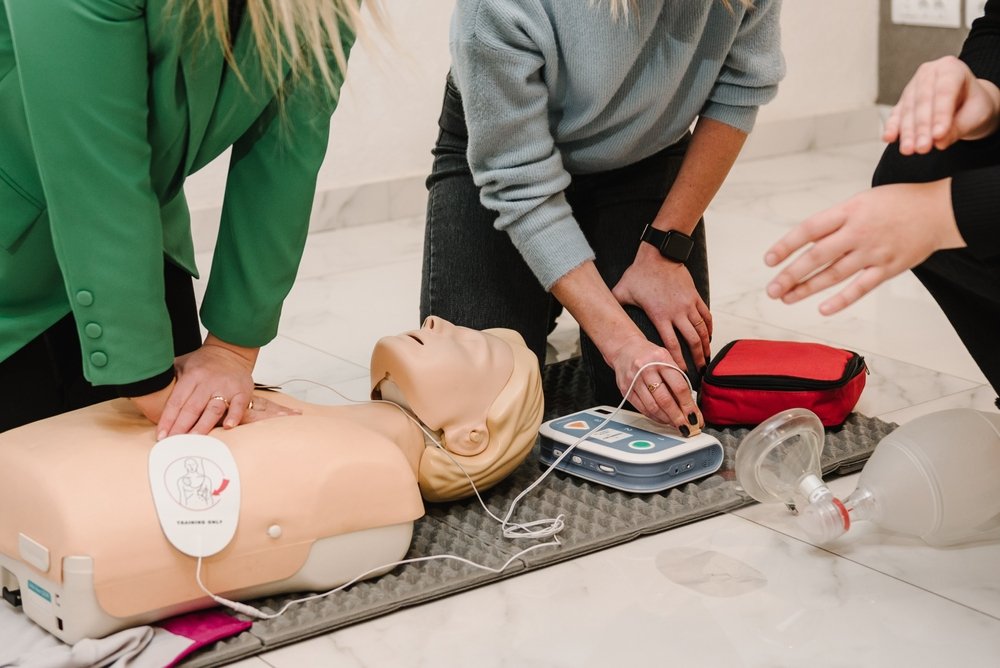
A sudden cardiac arrest can happen almost anywhere in Omaha, from a workplace near Aksarben Village to a gym in West Omaha, a church in Millard, or a gathering downtown. In those first few minutes, knowing how to respond can help bystanders move from uncertainty to action.
An automated external defibrillator, or AED, is designed so members of the public can use it. The device analyzes the person’s heart rhythm, determines whether a shock is appropriate, and provides step-by-step prompts. The American Heart Association emphasizes that AEDs are built for public use and will only advise a shock when the device detects a shockable rhythm.
Quick answer: The seven basic steps of using an AED are to recognize cardiac arrest and get help, begin CPR, turn on the AED, expose and prepare the chest, attach the pads, allow the AED to analyze the heart rhythm and deliver a shock if advised, and immediately resume CPR. Continue following the AED prompts until emergency medical personnel take over.
What Omaha residents should know
An AED provides voice or visual prompts that guide the rescuer through the process.
Someone should call 911 and retrieve an AED as soon as cardiac arrest is suspected.
CPR should continue with as few interruptions as possible, stopping when the AED directs rescuers to do so for analysis or a shock.
AED preparedness matters in busy Omaha settings such as schools, offices, churches, gyms, athletic facilities, and community gathering places.
Nebraska law addresses AED use and provides civil liability protections for certain people who provide emergency care with an AED in good faith.
Why Knowing the 7 Steps of Using an AED Matters in Omaha
Knowing the seven steps of using an AED can help Omaha residents respond more quickly when someone suddenly collapses and is not responding or breathing normally. Cardiac arrest requires immediate action, so familiarity with CPR, AED placement, and the device’s prompts can reduce hesitation while 911 and local emergency responders are on the way.
Omaha has a wide range of places where groups of people gather, including workplaces downtown, restaurants and entertainment venues in the Old Market, schools, athletic facilities, churches, recreation centers, and businesses throughout Douglas County. The city also includes active districts such as Benson, Dundee, Blackstone, Midtown Crossing, and Aksarben Village.
LifeGuard MD, Inc. is based in Omaha and provides AEDs, accessories, maintenance support, and First Aid, CPR, and AED training. We work with organizations that want their equipment and people prepared for a cardiac emergency.
Step 1: Recognize Cardiac Arrest and Get Help
The first step in using an AED is recognizing a possible cardiac arrest, checking that the scene is safe, checking the person for responsiveness and normal breathing, and getting emergency help immediately. If the person is unresponsive and is not breathing normally, have someone call 911 and send another person to retrieve an AED.
Abnormal gasping can occur during cardiac arrest and should not necessarily be mistaken for normal breathing. The goal is to recognize the emergency quickly rather than spending valuable time trying to determine exactly why the person collapsed.
In an Omaha workplace or public facility, this is where a practiced emergency response plan can make a difference. One person can contact 911 while another retrieves the AED and another begins CPR.
Step 2: Begin CPR
The second step is to begin CPR while someone retrieves and prepares the AED. CPR helps circulate blood during cardiac arrest and should be interrupted as little as possible while the rescue is underway.
If multiple trained rescuers are present, responsibilities can be divided. This is one reason hands-on training can be useful for Omaha workplaces, schools, churches, and organizations. Instead of figuring out roles for the first time during an emergency, participants can practice how CPR, calling 911, and AED retrieval fit together.
Step 3: Turn On the AED
The third step is to turn on the AED as soon as it arrives and follow its instructions. Modern AEDs provide prompts that tell the rescuer what to do next, which is why a person should not avoid using the device simply because they have never delivered a shock before.
The exact controls vary by AED model. Some devices have a clearly marked power button, while device-specific operation may differ. Once activated, listen carefully and follow the AED’s instructions.
For organizations throughout the Omaha metro, knowing the particular AED installed at the facility can further reduce uncertainty.
Step 4: Expose and Prepare the Chest
The fourth step is to expose the person’s chest so the AED pads can make proper contact with bare skin. Remove clothing covering the areas where the pads need to be placed and, when necessary, wipe a wet chest dry before applying them.
Do not place the pads over clothing. The illustrations included with the AED pads show where they belong.
This seemingly simple step is worth practicing. During an actual emergency in a busy Douglas County office, gym, school, or public venue, rescuers may be working under considerable pressure. Familiarity with the process can help keep everyone focused on the AED’s instructions.
Step 5: Attach the AED Pads
The fifth step is to remove the backing from the electrode pads and attach them to the person’s bare chest according to the illustrations provided with the AED. Connect the pads to the AED if the particular device requires a separate connector.
Pad placement matters because the AED uses the pads both to analyze the heart rhythm and, when appropriate, deliver a shock.
Rescuers should follow the diagrams on their specific AED pads rather than relying solely on memory. AED equipment can differ, so the instructions packaged with the device are an important part of the response.
Step 6: Let the AED Analyze and Deliver a Shock if Advised
The sixth step is to allow the AED to analyze the person’s heart rhythm without anyone touching the person, then deliver a shock only if the device advises one. The AED determines whether a shockable rhythm is present, so the rescuer does not make that medical decision.
When the AED announces that it is analyzing, make sure everyone is clear.
If a shock is advised, make sure no one is touching the person and follow the device’s directions for delivering the shock. Depending on the AED, that may include pressing a clearly marked shock button.
If the device says that no shock is advised, follow its prompt and return to CPR. A "no shock advised" message does not mean the emergency is over.
Step 7: Resume CPR and Continue Following the AED
The seventh step is to resume CPR immediately after a shock, or when the AED tells you to resume CPR if no shock is advised. Continue following the AED prompts and providing CPR until emergency medical personnel arrive and take over.
The AED may analyze the rhythm again as the response continues. Leave the pads attached and continue following its instructions.
For an Omaha organization, the goal of preparedness is not to turn employees or volunteers into emergency medical professionals. It is to help ordinary people recognize an emergency, call 911, provide CPR, retrieve the AED, and confidently follow the device until professional responders arrive.
Common AED Warning Signs and Situations to Recognize
Possible cardiac arrest should be treated as an emergency when a person suddenly collapses, is unresponsive, and is not breathing normally. The American Heart Association notes that abnormal gasping can occur during cardiac arrest.
Warning signs or situations that should prompt immediate assessment include:
A person suddenly collapsing.
A person who does not respond when you try to get their attention.
Absence of normal breathing.
Gasping or abnormal breathing in an unresponsive person.
A person becoming unresponsive during physical activity.
A coworker, visitor, student, athlete, or customer who unexpectedly collapses.
Any situation in which 911 instructions indicate that CPR and an AED are needed.
Do not delay emergency care while trying to diagnose the underlying cause yourself.
When to Call 911 and Use an AED
Call 911 immediately when a person is unresponsive and is not breathing normally, and have an AED brought to the person as quickly as possible. CPR and AED use are emergency actions that take place while professional medical help is being summoned and dispatched.
In an Omaha business, school, church, or athletic facility, responsibilities can be assigned in advance through an emergency response plan. Staff can know who calls 911, where the AED is located, how it is retrieved, and how responders will be directed to the patient.
Common AED Mistakes to Avoid
Common AED mistakes generally involve delaying action, interrupting CPR unnecessarily, or failing to follow the device’s prompts. The better approach is to activate emergency medical services, begin CPR, retrieve the AED, and follow its instructions carefully.
Mistake: Waiting for a trained medical professional to use the AED.
Consequence: Valuable time may pass before defibrillation is attempted.
Better approach: Use the AED and follow its prompts while emergency responders are on their way. AEDs are designed for public use.
Mistake: Touching the person during rhythm analysis.
Consequence: It can interfere with the analysis process.
Better approach: Make sure everyone is clear whenever the AED directs you not to touch the person.
Mistake: Putting pads over clothing.
Consequence: The pads do not have the intended direct contact with the chest.
Better approach: Expose the chest and place pads on bare skin as illustrated.
Mistake: Stopping after a "no shock advised" message.
Consequence: The person may still be in cardiac arrest.
Better approach: Resume CPR when instructed and continue following the AED.
Mistake: Not knowing where the AED is located.
Consequence: Responders may lose time searching through an Omaha facility.
Better approach: Keep the AED accessible, clearly identified, and included in staff emergency planning.
AED Preparedness for Omaha Businesses and Organizations
AED preparedness means more than simply purchasing a device. Omaha organizations can benefit from knowing where the AED will be located, who knows how to retrieve it, how employees will respond to cardiac arrest, and whether pads, batteries, and other equipment are maintained according to applicable manufacturer guidance.
Nebraska law states that, with specified exceptions, a person acquiring an AED must notify the local emergency medical service about the existence, location, and type of AED and changes to its location. The statute lists exceptions including AEDs acquired for private residences, health care facilities, and health care practitioner facilities.
We can help organizations understand AED equipment, accessories, maintenance, training, and cardiac emergency response planning. Our services include First Aid, CPR, and AED classes as well as AED maintenance support.
Ready to strengthen your emergency preparedness?
Comparing AED Training With Relying on Instructions Alone
AED instructions are designed to guide a rescuer through an emergency, while hands-on training gives participants an opportunity to practice the larger response before an emergency occurs. Both matter because an AED can provide real-time prompts, but training can familiarize people with CPR, pad placement, AED operation, and coordinating multiple rescuers.
For a workplace in the Old Market, a school in West Omaha, a church near Millard, or an athletic organization serving Sarpy or Douglas County, training can also expose practical questions. Where is the AED? Who retrieves it? Who meets EMS? Can everyone locate the device quickly?
Those details are easier to address before someone collapses.
AED Services in Omaha and the Surrounding Metro
Our Omaha-based team supports AED preparedness locally and beyond, including organizations in communities such as Bellevue, La Vista, Papillion, and Elkhorn. We work with businesses, schools, churches, first responders, and other organizations that need AED equipment, maintenance, training, or emergency response planning.
Whether your facility is in Douglas County or elsewhere in the metro, the objective is the same: make lifesaving equipment accessible and help people know what to do when an emergency happens.
The Cost of Being Unprepared for a Cardiac Emergency
Being unprepared for cardiac arrest can lead to lost time when people do not know where the AED is, hesitate to use it, or are unsure who should call 911 and begin CPR. A written plan, accessible equipment, regular maintenance, and training can address these preventable sources of confusion.
For Omaha employers and organizations, preparedness also means checking the AED before an emergency rather than discovering an equipment issue when someone needs it.
Do not wait for an emergency to test your plan
FAQ About Using an AED in Omaha
Can anyone use an AED in Omaha?
Yes. AEDs are designed so members of the general public can use them by following the device’s prompts. The American Heart Association states that medical training is not required to operate an AED because the device guides the user and determines whether a shock is appropriate.
What are the seven steps of using an AED?
The seven basic steps are to recognize cardiac arrest and get help, begin CPR, turn on the AED, expose and prepare the chest, attach the pads, let the AED analyze and shock if advised, and immediately resume CPR. Continue following the AED until emergency medical personnel take over.
Can an AED shock someone who does not need it?
An AED analyzes the heart rhythm and determines whether a shock is appropriate before advising or permitting the rescue sequence to proceed. The rescuer does not independently decide whether the person's rhythm requires defibrillation, which is one reason AEDs are designed to be usable by members of the public.
Should Omaha businesses train employees to use their AED?
Training can help employees become familiar with CPR, AED operation, equipment location, and their roles during an emergency. Although an AED itself provides prompts, practicing the overall response can help an Omaha workplace prepare for practical tasks such as calling 911, retrieving the device, performing CPR, and directing responders.
Where should an Omaha organization keep its AED?
An AED should be placed where it can be readily accessed during an emergency rather than locked away or difficult to locate. Organizations should consider how quickly someone can retrieve the device from the areas where employees, visitors, students, or customers spend time and use clear signage to make the AED easy to identify.
Does Nebraska provide legal protection for someone who uses an AED?
Nebraska law provides civil liability protection, subject to stated conditions and exceptions, for a person providing emergency care or treatment with an AED in good faith. The protection does not extend to willful, wanton, or grossly negligent acts, and the statute contains provisions specific to health care professionals and facilities.
Does an Omaha business need to tell local EMS that it has an AED?
Nebraska law generally requires a person acquiring an AED to notify local emergency medical service personnel of the AED's existence, location, and type, as well as changes in location. The statute contains exceptions, including devices acquired for private residences and certain health care settings.
What should I do if the AED says no shock is advised?
Resume CPR when instructed and continue following the AED's prompts. "No shock advised" does not necessarily mean the person has recovered. The device has determined that a shock is not appropriate at that moment, so continue the emergency response until EMS personnel arrive and take over.
Help Make Your Omaha Organization AED Ready
Knowing the seven steps of using an AED can turn an unfamiliar piece of emergency equipment into a tool people are prepared to use. For Omaha businesses, schools, churches, athletic programs, and community organizations, accessible equipment, maintenance, training, and a clear response plan can all support better emergency preparedness.
Build a More Prepared Omaha Workplace or Organization
We can help you understand your AED options and prepare your team with equipment, maintenance support, First Aid, CPR, and AED training.