
Incorporating the AHA’s Opioid Overdose Algorithm into CPR Training: Why It Matters
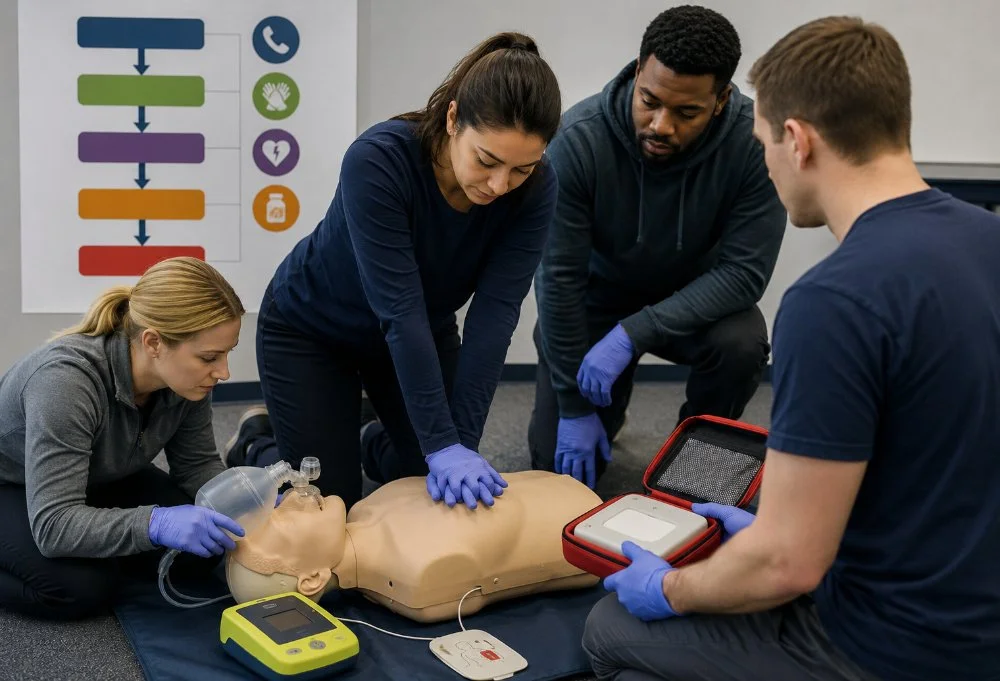
The opioid crisis in the United States continues to reshape how emergency responders and everyday citizens must think about life-saving care. As overdose-related emergencies grow more common in homes, public spaces, and workplaces, the skills required of a trained bystander have expanded well beyond standard chest compressions. The American Heart Association overdose algorithm, introduced in its landmark 2025 guidelines, reflects exactly how urgent and widespread this need has become.
Understanding this updated CPR overdose response is no longer optional for serious CPR students. It is a core competency.
What the 2025 AHA Guidelines Actually Changed
The 2025 American Heart Association Guidelines for Cardiopulmonary Resuscitation and Emergency Cardiovascular Care, published on October 22, 2025 in the journal Circulation, represent the first full revision of resuscitation guidance since 2020. The update touched several areas of emergency care, including choking protocols and pediatric training, but one of the most significant changes was its direct response to the opioid epidemic.
The new guidelines incorporate the first-ever public access opioid overdose algorithm, covering signs of overdose, when to administer naloxone, and when to provide rescue breaths. This is not a minor adjustment to an existing protocol. It is an entirely new framework designed to help bystanders and dispatchers act with confidence during a suspected opioid emergency, and it sits fully integrated within the broader CPR guidance rather than being treated as a separate public health topic.
For anyone enrolled in CPR training, opioid emergencies are now a required area of focus. The days of treating overdose response as a specialty skill reserved for paramedics or addiction counselors are over. The AHA has made it clear that the public must be prepared.
Why Opioids Require a Different Response Framework
Traditional cardiac arrest and opioid-induced unconsciousness share some surface similarities: a person collapses, breathing slows or stops, and the situation becomes life-threatening within minutes. However, the underlying physiology is different in important ways, and that difference shapes how a rescuer should respond.
Opioid overdoses account for 80 percent of all drug overdose deaths worldwide. When opioids suppress the central nervous system, they do so by binding to receptors that regulate breathing. A person in opioid overdose may still have a heartbeat when their breathing becomes dangerously compromised. This is a key distinction. In a standard cardiac arrest, the heart has stopped. In an opioid emergency, the respiratory system often fails first, and the heart may follow if the situation goes untreated.
Key overdose indicators identified in the guidelines include slow or absent breathing, choking or gurgling sounds, unconsciousness, pinpoint pupils, and blue or grey lips or fingertips. Recognizing these signs early is what allows a bystander to intervene before a respiratory emergency becomes a full cardiac arrest. This is precisely why opioid overdose CPR naloxone guidance must be taught together as an integrated skill set rather than in isolation.
The Role of Naloxone in Updated CPR Overdose Response
Naloxone, commonly known by the brand name Narcan, is a medication that can rapidly reverse the effects of opioids. It works by blocking opioid receptors in the brain and can restore normal breathing within minutes of administration. The 2025 AHA guidelines take a strong stance on making naloxone accessible and on training lay rescuers to use it.
The 2025 guidelines provide a new algorithm for treating individuals with a suspected opioid overdose, including public access instruction on when to use naloxone, with the important clarification that standard CPR should not be delayed. This is a nuanced but critical point. A rescuer should not spend so much time searching for or administering naloxone that they neglect to call 911 and begin CPR if the person is unresponsive and not breathing. The two actions must work in parallel, not in sequence.
The 2025 guidelines include strong recommendations for community availability of naloxone kits, similar to AED placement strategies, as well as an emphasis on training lay rescuers to recognize opioid overdose signs and administer naloxone. This approach mirrors the decades-long push to place automated external defibrillators in schools, airports, and office buildings. The logic is the same: the faster a life-saving intervention reaches a victim, the better the outcome. Updated CPR overdose response training now incorporates this naloxone-first-when-safe framework so that anyone who completes a course knows not just how to compress a chest but also how to recognize and address an opioid emergency from the first moment.
What This Means for CPR Training Programs and Instructors
The integration of the American Heart Association overdose algorithm into standard CPR training creates both an opportunity and a responsibility for training programs across the country. Instructors must now be fluent in opioid overdose recognition, naloxone administration, and the decision-making process that guides a bystander through the critical first minutes of an emergency.
The American Heart Association and American Academy of Pediatrics are releasing updated CPR and ECC training materials alongside the new guidelines to accelerate implementation. This means course developers, community organizations, and workplace safety programs have access to current, evidence-based content to update their curricula. The barrier to offering comprehensive opioid overdose CPR naloxone guidance within a standard CPR course has been significantly lowered.
The guidelines also recommend support for media campaigns, instructor-led training, and community training programs to improve lay rescuer response to out-of-hospital cardiac arrests. For CPR training providers, this is an invitation to expand their reach, particularly into communities most affected by the opioid epidemic. Schools, recovery centers, libraries, faith communities, and employers in high-risk industries are all logical partners for this kind of outreach.
The updated CPR overdose response framework also calls for integration at the dispatcher level. When someone calls 911 to report a possible overdose, the dispatcher should now be equipped to provide callers with clear, consistent instructions that align with the AHA algorithm. This requires training not just the public but also the emergency communications infrastructure that supports them.
Conclusion
The inclusion of the American Heart Association overdose algorithm in the 2025 CPR and ECC guidelines is one of the most meaningful shifts in resuscitation education in recent years. By treating opioid overdose response as an essential component of CPR training opioid emergencies can now be addressed with the same confidence and consistency as cardiac arrest. The updated CPR overdose response framework, built around early recognition, naloxone use, and coordinated action with emergency services, gives ordinary people the tools to save lives in situations that were previously seen as beyond their ability to help. Whether you are completing your first CPR course or renewing a certification you have held for years, the 2025 AHA guidelines make one thing clear: knowing opioid overdose CPR naloxone guidance is no longer a specialty skill. It is simply part of knowing CPR.
Will the Next Life We Save Be Yours?
At LifeGuard MD, Inc., we’re passionate about helping you create a safer environment where lives can be protected and saved. Whether you’re ready to equip your facility with high-quality AEDs or schedule professional CPR and AED training for your team, we’re here to guide you every step of the way. Reach out to us today to learn how we can help you strengthen your emergency preparedness and gain the confidence to respond when it matters most. Your safety is our mission; let’s make every second count together!