
AEDs in Hospitality and Tourism: Protecting Guests in Hotels, Resorts, and Venues
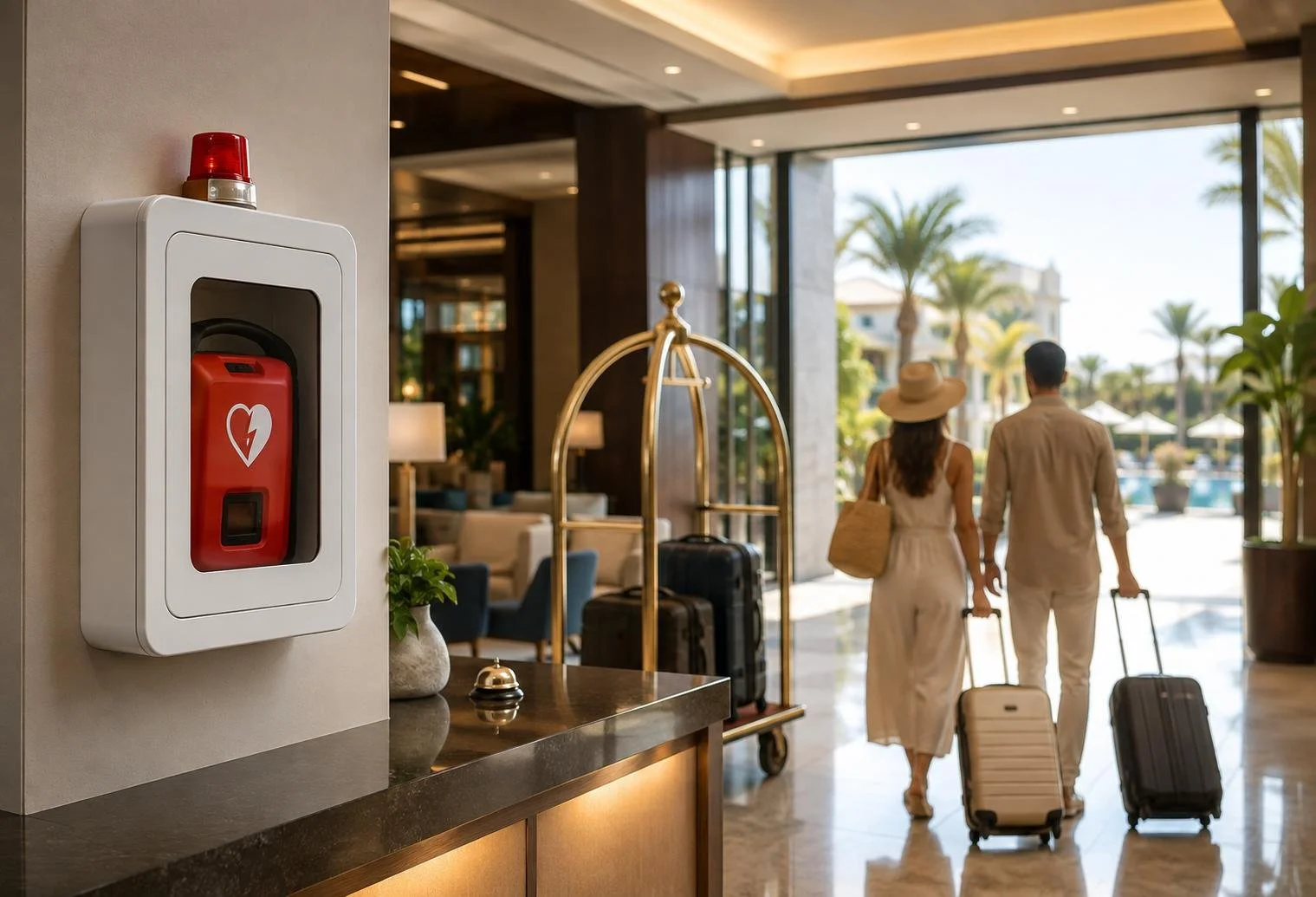
Hotels, conference spaces, entertainment venues, and tourism businesses are built around welcoming people, but large guest populations also create emergency-preparedness responsibilities. In Omaha, where visitors move between Eppley Airfield, downtown hotels, the Old Market, The RiverFront, and major event venues, having a clear response plan for sudden cardiac arrest can be an important part of guest safety.
Quick answer: AEDs can strengthen emergency preparedness in hotels, resorts, conference centers, and entertainment venues by making defibrillation available before emergency medical services arrive. An automated external defibrillator analyzes a person’s heart rhythm and provides instructions when a shock is appropriate, helping trained staff or other responders take action during a time-sensitive cardiac emergency.
For hospitality businesses, effective AED readiness involves more than purchasing a device. Placement, visibility, maintenance, staff awareness, emergency procedures, and compliance with applicable Nebraska requirements all matter.
What Local Hospitality Leaders Should Know
AEDs should be located where responders can reach them quickly, not hidden in an office or storage area that guests and staff cannot easily access.
Downtown properties serving visitors near CHI Health Center Omaha, the Old Market, and The RiverFront may experience changing guest volumes during conventions, concerts, sporting events, and tourism periods.
Staff should know where AEDs are located and what to do when someone becomes unresponsive and is not breathing normally.
Batteries, electrode pads, cabinets, signage, and device readiness should be reviewed according to manufacturer instructions.
Nebraska law includes notification requirements for many organizations that acquire an AED, so local operators should verify how those rules apply to their facilities.
Why AED Readiness Matters Locally
AED readiness matters locally because Omaha supports a substantial hospitality and event economy where thousands of residents and visitors can move through hotels, meeting spaces, attractions, restaurants, and entertainment districts on the same day. Visit Omaha reports thousands of hotel rooms downtown and more than 15,000 rooms across the metro area.
CHI Health Center Omaha anchors the downtown convention district near hotels, the Old Market, and the riverfront. Charles Schwab Field Omaha, Henry Doorly Zoo & Aquarium, Eppley Airfield, and other destinations also contribute to periods of concentrated visitor activity.
For organizations evaluating their emergency preparedness, LifeGuard MD, Inc. is the local business behind this guide. We encourage hospitality operators to think about AED readiness as a complete program rather than simply a device mounted on a wall.
Local Data or Field Observations
Local hospitality activity creates conditions where AED accessibility deserves deliberate planning because visitors may be unfamiliar with a building, employees may work across several departments, and event attendance can change dramatically from one day to another. Visit Omaha identifies more than 3,600 downtown hotel rooms near the convention district and describes Eppley Airfield as approximately four miles from downtown.
That means emergency planning should account for front desks, meeting rooms, fitness areas, pools, ballrooms, restaurants, event floors, and other high-traffic spaces rather than assuming one centrally located device will always be sufficient.
Local Impact
A well-planned AED program can improve a hospitality property’s ability to respond while 911 and emergency medical services are on the way. Sudden cardiac arrest can occur without warning, and the American Heart Association emphasizes CPR and rapid access to defibrillation as central parts of the response to cardiac arrest.
For area hotels and venues, preparedness also helps employees understand their roles during an emergency rather than losing valuable time searching for equipment or deciding who should respond.
Warning Signs Your AED Program Needs Attention
An AED program needs attention when equipment, placement, maintenance, or employee awareness could delay its use during an emergency.
Watch for these warning signs:
Employees cannot quickly identify the nearest AED.
The device is kept behind a locked door or in a difficult-to-reach location.
Directional signage is missing or difficult to see.
Battery or electrode pad expiration dates are not routinely checked.
Responsibility for inspecting the device is unclear.
Renovations or floor-plan changes have made the original location less practical.
New buildings, meeting areas, fitness facilities, or event spaces have opened without reviewing AED coverage.
Emergency procedures have not been reviewed with current employees.
When to Call a Professional
Hospitality operators should seek professional guidance when they are selecting AEDs, determining placement, reviewing readiness, or building a repeatable maintenance and response process. Staff can perform routine visual checks when appropriate, but decisions involving equipment selection, program design, regulatory obligations, and training needs deserve a more structured review.
This is particularly relevant for larger properties with multiple floors, detached facilities, expansive event areas, or changing crowd patterns.
Common Local Causes of AED Readiness Gaps
AED readiness gaps commonly develop because a hospitality property changes while its emergency plan remains the same. In the Omaha metro, renovations, convention activity, seasonal tourism, new amenities, and expanding event spaces can all change where people gather and how quickly responders can move through a building.
Common causes include outdated placement plans, expired supplies, employee turnover, missing signage, inaccessible cabinets, and assuming that emergency responders will arrive before on-site action is needed.
Prevention and Maintenance
Preventing AED readiness problems requires scheduled inspections, clear responsibility, visible placement, and periodic review of the entire emergency response plan. Follow the device manufacturer’s instructions for checking batteries, electrode pads, status indicators, accessories, and storage conditions.
Hotels and venues should also revisit placement after remodels, expansions, or operational changes. A device that was appropriately located several years ago may no longer serve the busiest parts of a property.
Nebraska organizations should also review applicable state requirements. Nebraska Revised Statute 71-51,102 states that, subject to listed exceptions, a person acquiring an AED must notify the local emergency medical service about the device’s existence, location, and type, as well as changes in location.
Expected Results
A properly maintained AED program should give employees and responders faster, clearer access to functioning equipment during a suspected sudden cardiac arrest. It should also reduce confusion about device location, inspection responsibility, emergency procedures, and equipment status.
No AED program can guarantee the outcome of a medical emergency. The goal is to remove avoidable obstacles so appropriate emergency action can begin as quickly as possible.
Common Mistakes
Common AED mistakes usually involve accessibility or program management rather than the technology itself.
Mistake: Putting an AED in a back office.
Consequence: Responders may lose time locating or accessing it.
Better approach: Choose visible, accessible locations based on how people actually move through the property.
Mistake: Installing the device and forgetting it.
Consequence: Pads or batteries may eventually require replacement.
Better approach: Assign responsibility for documented routine checks.
Mistake: Training only one employee.
Consequence: That individual may not be working when an emergency occurs.
Better approach: Develop broader staff awareness appropriate to the operation.
Common Local Scenario
A common local scenario is a busy downtown property hosting overnight guests while simultaneously handling a conference, banquet, or special event. Guest traffic may extend from the lobby to meeting rooms, restaurants, fitness areas, and upper floors.
If a cardiac emergency occurs, employees should not have to determine for the first time where the AED is located. Planning placement, accessibility, and response responsibilities in advance can make the emergency process more organized.
Related Service Solutions
AED-related solutions should address the entire readiness process, including appropriate equipment, accessible placement, replacement supplies, maintenance planning, and employee preparedness. The appropriate approach will depend on building size, occupancy patterns, operating hours, and the number of separate areas where guests and employees gather.
Comparing Your Options
Choosing between simply owning an AED and maintaining a complete AED program comes down to readiness. Purchasing a device provides the equipment, while a broader program addresses where it goes, who checks it, whether supplies are current, how employees find it, and how the organization incorporates it into emergency procedures.
For multi-floor hotels and larger event properties, evaluating more than one device location may also be appropriate based on layout and response needs.
Service Areas
We support organizations evaluating AED preparedness in Omaha and the surrounding metro area, including businesses serving Douglas County and nearby communities. Properties that accommodate visitors traveling between downtown, Eppley Airfield, west Omaha, La Vista, and Council Bluffs can benefit from reviewing emergency equipment as part of their broader guest-safety planning.
Cost of Ignoring AED Readiness
Ignoring AED readiness can leave a hospitality business with equipment that is difficult to locate, improperly maintained, or poorly incorporated into its emergency procedures. The most serious consequence is lost time during a cardiac emergency, when rapid CPR and access to defibrillation can be critical.
A periodic readiness review is a practical way to identify problems before an emergency exposes them.
Frequently Asked Questions
Do hotels in Omaha need AEDs?
AED requirements can depend on the type of facility and applicable laws, so hotel operators should verify their specific obligations rather than assume every property is governed identically. Regardless of whether a particular facility is required to have one, an AED can be an important component of a hotel’s voluntary emergency-preparedness program.
What does Nebraska law say about acquiring an AED?
Nebraska law states that, subject to specified exceptions, a person acquiring an AED must notify the local emergency medical service about the existence, location, and type of the device and later changes in its location. The statute also contains provisions addressing civil liability for good-faith emergency AED use.
Where should an AED be placed in an Omaha hotel?
An AED should be placed where it is visible, accessible, and reasonably reachable from areas where guests and employees spend time. Depending on the property, that could mean evaluating the lobby, conference rooms, fitness facilities, pools, restaurants, ballrooms, and guest-room floors rather than automatically choosing a back-office location.
Why are AEDs relevant for Omaha event venues?
AEDs are relevant because event venues can place large numbers of people in one facility at the same time. Downtown attractions and event spaces such as CHI Health Center Omaha operate within a broader district that includes thousands of hotel rooms, restaurants, entertainment areas, and visitor activity.
How often should an AED at a Nebraska hospitality property be checked?
AEDs should be inspected according to the manufacturer’s instructions and the organization’s established readiness process. Checks commonly include device status indicators, battery condition, electrode pad dates, accessories, cabinet condition, and accessibility. Responsibility should be assigned clearly so routine inspections do not disappear during staffing or management changes.
Can someone without medical training use an AED?
AEDs are designed to analyze heart rhythm and provide prompts that guide the responder through the process, but employee CPR and AED training can improve preparedness and confidence. During a suspected cardiac arrest, responders should activate emergency medical services, begin appropriate CPR, and use an available AED according to its instructions.
Should Omaha hotels consider more than one AED?
Larger hotels may need to evaluate multiple AED locations when one device cannot be reached quickly from all major areas of the property. Building size, number of floors, conference facilities, fitness areas, pools, restaurants, occupancy patterns, and physical barriers should all be considered when developing a placement plan.
Do AED pads and batteries expire?
AED batteries and electrode pads have manufacturer-specified service lives or replacement schedules, so they need ongoing monitoring. An AED mounted on the wall should not be treated as permanently maintenance-free. Hospitality operators should follow the manufacturer’s requirements and maintain a routine inspection process so equipment is ready when needed.
Protect Guests With a Stronger AED Readiness Plan
Guest safety depends on preparation long before an emergency begins. For Omaha hotels, venues, tourism businesses, and other hospitality organizations, a well-planned AED program can help make lifesaving equipment easier to locate, maintain, and use when every moment matters.
Contact LifeGuard MD, Inc. to discuss AED readiness for your local hospitality property.